Good to Know
What few people know
Something new in the West. The BVB as clear number two in the Bundesliga behind Bayern München and alongside the record champions the only "global player" in German football? A fan magnet, a kind of substitute religion in black and yellow with 80,000 pilgrims at the Signal Iduna Park every other weekend? That was not always the case.
More precisely: it seemed unthinkable for a long time and only came about through several, sometimes spectacular, turning points in the club's history. And no, Borussia Dortmund were not a "tradition club" for a long time either. When clichés of Ruhr football were bandied about in the first decade after the war, it was Schalke 04 with their immortal heroes Ernst Kuzorra and Fritz Szepan who embodied the region.
What few people know today: a noteworthy cult around Borussia Dortmund only developed well after the turn of the millennium. The signs that something was changing in the football-breathing Ruhr after the devastating war were first detected by the Rhein-Ruhr-Zeitung in their football preview on May 18, 1947. "Schalke — or perhaps Borussia?" read the headline, "could it really be that Borussia Dortmund stand a chance in the final?" The disbelief of the experts was not unfounded. Borussia who? Until 1930, Borussia Dortmund were a third-division side, competing against the likes of SV Langendreer 04 or Sportfreunde Dortmund.
During the turbulent 1920s, the club faced its first major financial crisis. Heinz Schwaben, director of the Dortmunder Union Brewery, personally guaranteed the BVB's debts. Under the leadership of August Lenz, Dortmund's first German international, the club finally reached the top-flight "Gauliga" in 1936. There, during the Nazi era, BVB had the reputation of a "fellow traveller" — the subscription champion Schalke 04, with their formidable modern short-passing game (the "Schalker Kreisel"), were simply unbeatable. Two runners-up finishes (1938 and 1942) remained BVB's greatest achievements.
Then the "turn in the West," as Hans Dieter Baroth wrote in his 1989 book "Jungens, Euch gehört der Himmel — The History of the Oberliga West 1947-1963": "On Monday there are no newspapers. The Rhein-Ruhr-Zeitung reports on May 20, 1947: Schalke no longer Westphalian champions. (…) The great surprise in West German football is the 2:3 (1:0) of Schalke 04 in front of 30,000 spectators in Herne against Borussia Dortmund in the final for the Westphalian Football Championship." Schalke were so deeply wounded that they boycotted the award ceremony. In the years that followed, Borussia consolidated their newly won position at the top.
Between 1947 and 1950, they won the West German championship four times in a row. The attempt to claim the national title failed in 1949 in the final against VfR Mannheim (for now), but Borussia Dortmund were on their way to becoming a German top side. Before the introduction of the Bundesliga (1963), they won the West German championship three more times and reached two further finals (1949 and 1961). Most importantly: in 1956 and 1957, the Black and Yellows won the national title with the same starting line-up in both finals — a first in German football.
By the early 1960s, Borussia boasted a hungry, well-drilled squad featuring players like Hans "Til" Tilkowski, Helmut "Jockel" Bracht, Reinhold "Zange" Wosab, Wolfgang Paul, Alfred "Aki" Schmidt, Dieter "Hoppy" Kurrat, "Timo" Konietzka and Gerd Cyliax — a team that continued its success into the new Bundesliga era. In 1965, Dortmund won the DFB-Pokal and a year later, in Glasgow, became the first German club to win a European trophy, beating heavily favoured Liverpool 2-1 after extra time in the Cup Winners' Cup final. The first Bundesliga title was thrown away on the final stretch amid the celebrations following the Glasgow triumph, with BVB finishing second behind 1860 Munich.
A turning point.
After a solid Bundesliga start, BVB became a "mid-table team" following the European Cup triumph: in the years after the victory over Liverpool and the runners-up finish, Dortmund only managed to challenge for the title once more in 1967 (third place). The ageing European Cup heroes could no longer improve, and in 1969 the outstanding striker Lothar Emmerich was sold after yet another financial squeeze.
As early as 1963, the golden times in the "Pott" seemed to be fading: "The final season of the Oberliga West had a symbolic character," wrote Baroth, "the mine closures had begun, pit towers collapsed under demolition charges." From the late 1960s, Borussia Dortmund suffered under this "structural change," as politicians euphemistically called the downward spiral. Attendance fell from over 26,000 (1966/67) to 16,000 (1971/72), partly because of the Bundesliga match-fixing scandal — in which BVB were not even involved. In 1972, BVB were relegated from the Bundesliga for the first time — and, strapped for cash, scraped through in the Regionalliga and 2. Bundesliga.
Particularly painful for die-hard Borussen: in 1974, Schalke came for a charity match…
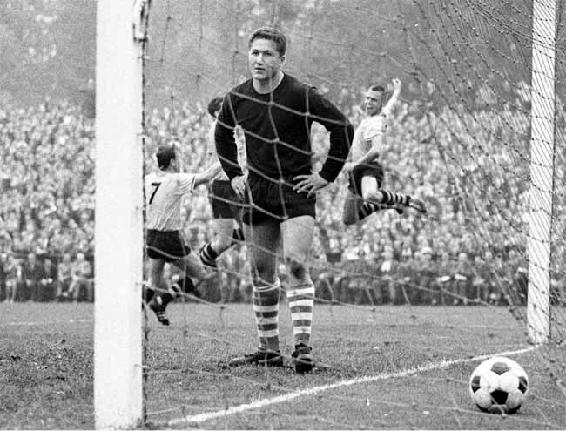
What is also gladly overlooked today: Dortmund were a coaching carousel long before their relegation. After the departure of successful coach Willi "Fischken" Multhaup in 1966, Dortmund lost all continuity in the coaching position. Six coaches in six years came and went at the little Stadion an der Roten Erde before relegation struck in 1972. In the search for lost time, a total of eight coaches tried their luck at BVB from 1972 onwards. Only the Essen-born Otto Rehhagel had limited success, achieving promotion back to the Bundesliga in 1976. After Rehhagel's dismissal on April 30, 1978, a further 16 (!) coaches followed in the eight years before the fateful turning point of 1986.
Big names like Udo Lattek, Karl-Heinz Feldkamp, Erich Ribbeck, Pal Csernai and Branko Zebec — in Dortmund, almost everyone got a turn! A low point was the 1983/84 season, when four coaches — Uli Maslo, Helmut Witte, Heinz-Dieter Tippenhauer and Horst Franz — greeted the journalists in succession. Tippenhauer was pushed back to his managerial position after just two matches, and the fans at the Westfalenstadion could barely be restrained from climbing the perimeter fences. It was the 34-year-old Reinhard Saftig who, by securing survival through the relegation play-offs in 1986, finally turned the tide.
And surprisingly: the fact that the Borussia ship reached calmer waters was thanks to a young lawyer who served as the "shadow man" on the 1984 emergency board under Dr. Reinhard Rauball, primarily overseeing the financial consolidation of the Ruhr club, which was 8.4 million Marks in debt. His name: Dr. Gerd Niebaum.
No other president at Borussia Dortmund embodies rise and fall like Dr. Gerd Niebaum, born October 23, 1948 in Lünen. Elected as Dr. Rauball's successor in 1986, he was seen as the great hope. That he brought in local sponsors and led the club into European competition as fourth-placed finishers just a year after near-relegation in 1986 was just the beginning of a new euphoria around Black and Yellow. The philosophy: build with players from the region! In 1986, Borussia surprisingly signed striker Frank Mill from Rhineland namesake Mönchengladbach. Together with Siegerland native Norbert "Nobby" Dickel, he formed a strike partnership that half the league envied.
"Frankie" and "Nobby" fired BVB to the UEFA Cup quarter-finals in 1987 and the DFB-Pokal triumph in 1989 — the first trophy in 23 years. The reception for the "Heroes of Berlin" at Dortmund's Friedensplatz is a piece of city history. Another transfer masterstroke in the early Niebaum years was the surprise signing of Frankfurt's midfield jewel Andreas Möller.
Niebaum's greatest coup, however, was the hiring of the previously unknown Lörrach native Ottmar Hitzfeld in summer 1991. Hitzfeld and Niebaum became the new "Dynamic Duo" of German football. Their strategy: bring back mercenaries from the Lira paradise of Italy. This put them a step ahead of industry leader Bayern, who between 1991 and 1996 only managed to "grab" the championship trophy once. Bundesliga matches and European nights in Dortmund became events from 1992 onwards. The Westfalenstadion, built in 1974 for the World Cup in West Germany, was rechristened the "Mailänder Scala of German football" by Munich's Kaiser Franz Beckenbauer.
The bigwigs from Munich, still playing in the draughty Olympiastadion, looked almost enviously towards Dortmund, where media frenzy and glamour in the style of "FC Hollywood" had (still) no place. Michael Meier, poached from Bayer Leverkusen as manager in 1989, turned Borussia Dortmund into a brand — and was named "Manager of the Year" by Kicker sports magazine in both 1992 and 1993, a fact rarely acknowledged today.
Frequently Asked Questions
How many coaches has BVB had?
Borussia Dortmund have had over 40 head coaches since 1966, including four in a single season (1983/84).